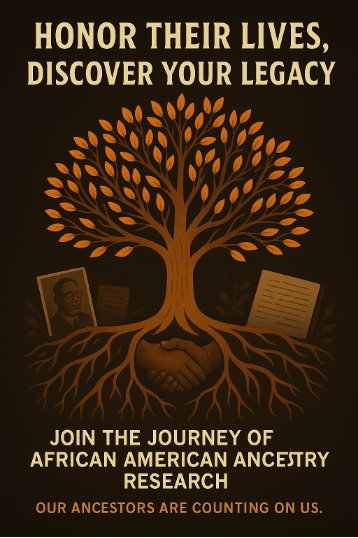

At the crossroads of history and hope, the voices of our ancestors call out to be heard. As the Descendant Project Researcher at the University of Virginia and a proud member of the nonprofit “Descendants of Enslaved Communities”, (https://www.descendantsuva.org) I have witnessed firsthand the incredible power descendants hold in uncovering, preserving, and honoring African American history. Today, we stand at a pivotal moment where more descendants must step forward to uncover the lives and legacies of those who came before us. Their lives, whether free or enslaved, “matter.” Their contributions, often omitted from traditional narratives, “matter.” And you — as a descendant — “matter” in reclaiming this truth.
For too long, African American ancestors have been treated as invisible or incidental in history books, records, and public memory. Now, there is an attempt to erase certain history. But genealogy gives us the tools to rewrite that story—to reframe our ancestors not as nameless, faceless figures but as mothers, fathers, farmers, teachers, soldiers, artisans, and leaders who shaped the foundation of America.
Genealogy is a form of activism. By researching, preserving, and sharing the lives of our ancestors, we give them the dignity, voice, and place in history they have always deserved. As a descendants, we bring something unique to this work:
• Family knowledge that might not exist in any document.
• Oral histories passed down through generations.
• Photos, letters, Bibles, land deeds, and other artifacts kept within families.
• Stories of survival and success that help fill in the gaps left by missing or damaged historical records.
Without descendants, much of this priceless knowledge would remain hidden forever. Researching African American ancestry is not without obstacles. We confront missing records, forced separations, name changes, limited documentation, and the brutal reality of slavery’s erasure. However, while the challenges are real, so are the strategies and resources to overcome them.
Here are a few resources to get involved with to help you get started:
• AAHGS (Afro-American Historical and Genealogical Society): A national organization dedicated to African American genealogy, offering chapters, mentorship, and conferences.
• The Black Pearls of Genealogy (thebpog.org) A website with numerous tools recognized as a one-stop source for African American genealogy.
• NGS (National Genealogical Society): Educational opportunities, research guides, and access to tools for genealogists at all stages.
• MAAGI (Midwest African American Genealogy Institute) is an intensive program that provides expert-led training specifically for African American family history research.
• The International African American Museum (www.iaamuseum.org) has a wealth of information within its Center for Family History. Monthly podcasts, tips, blogs, and archives are available for review.
• Local & state archives, courthouses, and historical societies: Hidden gems of information exist in deed books, tax lists, wills, Freedmen’s Bureau records, emancipation papers, and newspaper archives.
• DNA Testing and Analysis: Genetic genealogy can connect distant cousins and provide clues where paper trails end.
Realize all this will take some time. (I am sure you have noticed my gray hair). This type of research requires patience, persistence, and a willingness to search creatively across multiple sources — but the results are life-changing. This all matters for you, your family, and the future. Engaging with your family history is not just an act of remembrance — it’s a gift to future generations. It’s important for us as African Americans to realize knowing your ancestry helps with:
• Healing and Identity: Knowing where you come from gives you strength. It affirms identity, fosters pride, and can even heal historical wounds.
• Honoring Our Ancestors: Many of our ancestors endured unimaginable hardships. Researching and telling their stories honors their sacrifices and ensures they are never forgotten.
• Connecting Families: Many African American families were separated by slavery, migration, and systemic injustice. Genealogy can help reconnect lost branches and create new bonds.
• Teaching the Next Generation: By preserving and sharing your family’s history, you ensure that the stories of perseverance, resilience, and excellence are passed down and continue to inspire.
I want to take a moment to recognize the many descendants and projects that have already taken up this calling—who spend evenings pouring over old records, traveling to ancestral towns, attending genealogy workshops, or interviewing elders at family reunions.
You are the bridge between the past and the future.
You are giving voice to those who were silenced.
So, I “Thank you.”
I am calling “A Call to Action: Join the Movement.”
If you have ever wondered about your ancestors, now is the time to begin. Start small — ask a question, write down a family story, explore a census record. Or, if you are ready, dig deeper — attend a conference, join a genealogical society, test your DNA, and collaborate with local researchers.
• You don’t have to be a professional genealogist to make an impact.
• You only need the passion and the commitment to honor your family’s legacy.
• Every name you discover is a victory.
• Every story you share is a restoration.
• Every ancestor you reclaim is a light passed forward into the future.
Together, we can give voice to the millions of African American ancestors whose lives helped build this nation.
We can honor them properly — with truth, dignity, and pride.
I personally am researching for descendants of the enslaved laborers from central Virginia who helped to build the University of Virginia. The counties I research looking for descendants are: Albemarle, Buckingham, Culpeper, Greene, Buckingham, Fluvanna, Louisa, Nelson, Orange and Rockingham.
Start your journey today. Our ancestors are waiting. Here is a list of a few descendant groups and resources to checkout:
Georgetown Memory Project: https://gu272.americanancestors.org
Tulsa Identification Project: https://www.intermountainforensics.com/tulsadnaproject
African Indians of the 5 Civilized Tribes Foundation: https://www.facebook.com/profile.php?id=100064531306088
Universities Studying Slavery: https://slavery.virginia.edu/universities-studying-slavery-uss-the-birth-of-a-movement/
Midwest African American Genealogy Institute (MAAGI) https://www.maagiinstitute.org
Freedmen Bureau Friday’s Every Friday at 7pm EST hosted by me: https://us02web.zoom.us/meeting/register/tZMkcO6trzgrEtQ_2LEZM288-eldaIzEZ85F

 Family Tree Girl
Leave a reply to singuefield1783 Cancel reply